
BEST CITIES TO LIVE IN LATVIA
Latvia can suit people who want to live in the European Union with short travel distances, access to the Baltic Sea and a calmer pace than in the major capitals of Western Europe. The city you choose affects more than rent: it shapes access to jobs, schools, healthcare, transport and the languages used in everyday life. The legal basis for moving to Latvia, the documents required and the first practical steps depend on the purpose of the move.
Riga remains the country’s main centre for work and education, while Liepaja, Jurmala, Daugavpils and Jelgava offer different balances between urban life, access to nature and housing costs. The five cities below suit different plans: an international career, study, family life, regional employment or living by the sea.
AT A GLANCE
- Riga is the strongest choice for international companies, education and the widest job market, but it requires the largest housing budget.
- Liepaja combines a coastal lifestyle, port-related employment and a slower pace.
- Jurmala suits people who value the sea and proximity to Riga, but its resort housing market can be expensive.
- Daugavpils and Jelgava offer a more measured pace and more affordable rent, although their job markets are smaller than Riga’s.
CONTENTS
How to choose a city in Latvia
Start with the job market. Most international employers, financial firms, IT teams, logistics businesses and service companies are based in Riga; in regional cities, it is more important to check demand for a specific occupation, Latvian-language requirements and the possibility of remote work. In the second quarter of 2026, the average gross salary in Latvia reached €1,886 per month, but the gap between the Riga region and Latgale remained substantial.
For families, the commute to work and school, the availability of childcare, winter utility bills and the need for a car are equally important. Riga has the most developed public transport system; Jurmala works well for regular trips to the capital; and daily routes tend to be shorter in Liepaja, Daugavpils and Jelgava. Before signing a rental agreement, confirm not only the rent but also heating bills, the condition of the building and the deposit terms.
The language environment also varies. English is more common in international companies and services in the capital, but Latvian is needed for long-term integration, client-facing work and dealings with public authorities. Russian is widely used in daily life in Latgale and some coastal cities, but it does not replace the official language for most formal procedures.
City comparison
LATVIA’S BEST CITIES FOR RELOCATION: COMPARISON
| City | Population | Best suited to | Main reason to choose it |
| Riga | about 605,000 | Professionals, students, families and entrepreneurs | The broadest choice of jobs, education and services |
| Liepaja | about 67,000 | People who value the sea and a quieter urban pace | Coastline, port economy and more affordable housing |
| Jurmala | about 56,000 | Remote workers and higher-income families | A resort environment close to Riga |
| Daugavpils | about 78,000 | People seeking a measured pace and moderate costs | Affordable life in a major regional centre |
| Jelgava | about 55,000 | Students, families and people working in Riga | A university city with convenient links to the capital |
RIGA

Riga is Latvia’s most versatile relocation choice. It concentrates international companies, banks, IT teams, logistics, retail and public institutions, giving skilled candidates more opportunities without relocating to another part of the country. Applicants should compare a vacancy with the professions in demand in Latvia and assess their expected take-home pay before committing to a rental contract.
The capital also offers the largest concentration of universities, research centres and English-taught programmes. Daily life is shaped by public transport, historic neighbourhoods, parks and proximity to the airport, but rent is noticeably higher than in regional centres. It is best to view a district during peak hours: the commute to an office, school or university can matter more than a nominally central address.
RIGA: KEY POINTS
| Factor | What to consider |
| Work | The broadest job market: IT, finance, logistics, services, retail and education |
| Housing | The country’s highest rents; district, heating and building condition matter |
| Transport | Buses, trams, trolleybuses and suburban trains make a car optional for many residents |
| Lifestyle | Latvia’s most international city, with cultural events and services throughout the year |
| Best suited to | Professionals, students, families and people seeking an active urban environment |
LIEPAJA

Liepaja is on the Baltic Sea coast and has a noticeably slower pace than Riga. People choose it for its long beach, green districts, historic architecture and compact layout: many daily journeys can be made on foot or by bicycle. The local economy is linked to the port, manufacturing, logistics, tourism and services, so there are fewer vacancies than in the capital, but housing competition and daily life are generally less intense.
The city suits people who work remotely or seek employment in the regional economy. Winter winds from the sea, heating costs and the distance from Riga-based employers need to be considered, but summer brings a combination that is rare in Latvia: full urban infrastructure and life by the sea. Study opportunities and cultural life are additional advantages for students and families who do not need the capital’s scale.
LIEPAJA: KEY POINTS
| Factor | What to consider |
| Work | Port-related work, logistics, manufacturing, tourism, services and remote employment |
| Housing | Usually more affordable than Riga, with a smaller supply of high-quality rentals |
| Transport | A compact city with a tram system; a car is not essential for everyone |
| Lifestyle | Sea, beach, cultural events and a calmer everyday rhythm |
| Best suited to | Remote workers, families and people who want to live by the sea |
JURMALA

Jurmala stretches along the Gulf of Riga and consists of districts with distinct characters, from busy Majori to quieter Lielupe, Bulduri and Kauguri. It is not a suburb in the usual sense but an independent resort city with pine forests, beaches, health resorts and a rail connection to the capital. Central Riga is around half an hour away by train, which makes Jurmala practical for people whose work or studies are in the capital.
The city’s main advantage is its living environment: seaside walks, clean air and access to nature without giving up urban services. The main limitation is that renting or buying in popular districts can be expensive, while the local job market is much smaller than Riga’s. For permanent relocation, it is better to assess Jurmala as a city of daily routines, commuting, winter bills and seasonal housing demand rather than simply as a holiday destination.
JURMALA: KEY POINTS
| Factor | What to consider |
| Work | Tourism, wellness services and property; many residents commute to Riga |
| Housing | Resort districts are expensive, especially near the sea and railway stations |
| Transport | Trains and the main road connect the city with Riga; a car is more useful in outlying districts |
| Lifestyle | Beach, pine forest, a calm environment and seasonal resort activity |
| Best suited to | Families, remote workers and people who want to live close to Riga |
DAUGAVPILS

Daugavpils is Latvia’s second-largest city and the main centre of Latgale. It has a compact layout, a tram network, a historic fortress and a more affordable cost of living than Riga. Russian is widely used in daily conversation, but Latvian remains essential for public-sector work, education and long-term integration.
The city makes sense for people who do not need the capital’s job market and value a measured pace, short daily routes and moderate costs. Employment is concentrated in manufacturing, retail, education, healthcare, transport and municipal services, so a move for work should be based on a specific employer or vacancy. Daugavpils cannot match Riga’s number of international jobs, but it offers more predictable daily life and a strong regional identity.
DAUGAVPILS: KEY POINTS
| Factor | What to consider |
| Work | Manufacturing, retail, healthcare, education, transport and municipal services |
| Housing | Usually more affordable than Riga and Jurmala, with a smaller rental market |
| Transport | Trams and buses cover the main districts; the city is also convenient for walking |
| Lifestyle | A calm regional centre with a visible historical and cultural identity |
| Best suited to | Families, retirees, remote workers and specialists with a confirmed vacancy |
JELGAVA
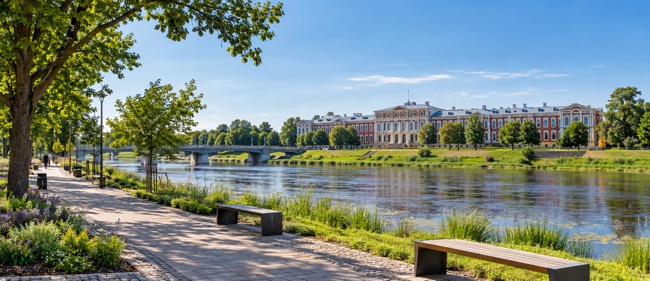
Jelgava is about 45 kilometres from Riga and combines a university environment with the measured pace of a smaller city. The Latvia University of Life Sciences and Technologies gives the city a visible student population and supports local services, housing and cultural activity. Students choosing Jelgava should compare the language of instruction, admission requirements and cost with other Latvian universities.
Jelgava suits people who do not want the density of the capital but still need access to Riga for work, the airport and some services. The local economy is based on education, food production, manufacturing, logistics and retail. When choosing a home, check train timetables or the actual driving route: a daily commute to Riga can be practical, but it should not turn the advantages of a quieter city into hours spent travelling.
JELGAVA: KEY POINTS
| Factor | What to consider |
| Work | Education, manufacturing, agriculture, logistics, retail and commuting to Riga |
| Housing | More affordable than Riga; demand is stronger near the university and transport links |
| Transport | Convenient rail and road links to Riga; distances inside the city are short |
| Lifestyle | A university city on the Lielupe River, with a calm setting for study and family life |
| Best suited to | Students, families and professionals working in Jelgava or Riga |
Housing budget and first expenses
The first month after relocation is almost always more expensive than a normal month: rent is only part of the bill, alongside the deposit, utilities, phone service, transport and basic purchases for the home. Average prices in Latvia provide a starting point for a relocation budget, but the final amount depends on the city, district, condition of the property and terms of the contract.
A single person should normally have enough reserve for at least two housing payments, as the deposit is often equal to one month’s rent. If accommodation is arranged before arrival, confirm whether utilities are included, how winter heating is charged and whether an agency fee applies.
MAIN MONTHLY EXPENSES IN LATVIA
| Expense | Euro |
| One-bedroom apartment in the city centre | €363.33 |
| One-bedroom apartment outside the centre | €268.93 |
| Utilities for an 85 m² apartment | €287.54 |
| Monthly public-transport pass | €30.00 |
| Broadband internet, monthly | €17.27 |
IMPORTANT
Utility bills in Latvia depend heavily on the heating season, apartment size and the building’s energy efficiency. Ask the landlord for the previous winter’s bills before renting: they give a far more realistic picture of the cost of living.
Your reserve should cover more than monthly expenses: include the deposit, unexpected purchases and any period spent finding work. The savings calculator can help turn that target into a monthly savings plan.
What changed over the last year
Latvia’s statutory minimum wage increased to €780 gross per month on 1 January 2026. In the second quarter, average gross pay for full-time-equivalent work reached €1,886, while median gross pay was €1,527. This matters when choosing a city: an offer close to the minimum wage is unlikely to cover independent rent and all everyday costs in Riga or Jurmala without additional household income.
Regional differences remain substantial. Average gross pay in the Riga statistical region was €2,068 in the second quarter of 2026, compared with €1,365 in Latgale. A lower-cost regional city can therefore come with fewer vacancies and lower pay, so rent should never be compared in isolation.
For a long-term move, the residence basis should be chosen before the city. Work, study, business and family routes each require different documents, and the chosen city should match where you will actually work, study and build daily life.
FREQUENTLY ASKED QUESTIONS
Which Latvian city is best for work?
Riga has the broadest choice of vacancies, especially in international companies, IT, finance, logistics and services. For regional employment, find a specific vacancy before choosing the city.
Where is it cheaper to live in Latvia?
Rent in Daugavpils, Liepaja and Jelgava is usually more affordable than in Riga and resort-oriented Jurmala. Local salaries, utility bills and the size of the job market also need to be considered.
Is Jurmala suitable for permanent living?
Yes, for people who value the sea, a calm environment and proximity to Riga. Its main limitations are higher rents in popular districts and a smaller local job market.
Is a car necessary in Latvia?
In Riga, Liepaja, Daugavpils and Jelgava, many residents can rely on public transport and walkable daily routes. A car is more useful in suburbs, some parts of Jurmala and for frequent travel between cities.
Which languages are spoken in Latvia?
Latvian is the official language. Russian is widely used in daily conversation in some cities, while English is more common in international companies and tourism, but Latvian is needed for long-term integration.
Sources
- Central Statistical Bureau of Latvia — city population, employment and wage data.
- Ministry of Welfare of Latvia — statutory minimum wage information.
- Numbeo — housing, services, transport and communication cost indicators for Latvia.
Founder and Editor-in-Chief of WageCentre, with a degree in finance and 15+ years of professional experience. He writes about salaries, taxes, labour markets, immigration and financial planning for relocation.
Comments