
BEST CITIES TO LIVE IN LITHUANIA
Lithuania attracts people relocating for its proximity to the Baltic and Nordic countries, practical urban infrastructure and a clear difference between the pace of the capital and regional cities. The city you choose affects access to vacancies, housing costs, language use, children’s education and the need for a car. The documents and first steps depend on the purpose of moving to Lithuania.
Vilnius has the broadest job market and the most international environment; Kaunas combines universities and industry; Klaipeda suits people who want a coastal city; and Siauliai and Panevezys offer a calmer daily routine. The five cities below provide different options for professionals, families, students and remote workers.
AT A GLANCE
- Vilnius is the strongest choice for an international career, education and active urban life, but it has the country’s highest rents.
- Kaunas suits students, engineers and families who want a major city without capital-city density.
- Klaipeda combines a port economy, the sea and a calmer pace.
- Siauliai and Panevezys offer more moderate costs, short daily routes and regional job markets.
CONTENTS
How to choose a city in Lithuania
Start with work. Vilnius concentrates international companies, financial services, IT, start-ups and services; Kaunas has strong engineering and manufacturing employers; and Klaipeda is linked to the port, logistics and maritime business. In the first quarter of 2026, the average gross salary in Lithuania reached €2,526.80 per month, but this national average does not replace an assessment of a specific vacancy, its tax treatment and local rent.
For families, compare a district with the route to childcare, school and work. Public transport covers most daily journeys in Vilnius and Kaunas, while a car can be more useful in suburbs and smaller cities. Before renting a home, ask to see winter utility bills: heating costs depend on the condition of the building, apartment size and the type of heating system.
Language affects integration and career prospects. English helps in international companies, Russian is understood by part of the older population, but Lithuanian is needed for long-term client-facing work, public authorities and local daily life. A regional city does not always mean harder adaptation, but the range of vacancies and English-language services is usually narrower.
City comparison
LITHUANIA’S BEST CITIES FOR RELOCATION: COMPARISON
| City | Population | Best suited to | Main reason to choose it |
| Vilnius | about 607,000 | Professionals, students, families and entrepreneurs | The widest choice of jobs, education and international services |
| Kaunas | about 304,000 | Students, engineers and families | University environment and developed industry |
| Klaipeda | about 160,000 | People who value the sea and a port economy | The country’s only major coastal city |
| Siauliai | about 111,000 | Families and people seeking a calm regional centre | Moderate costs and short daily routes |
| Panevezys | about 89,000 | Manufacturing workers, families and remote professionals | A compact city between Vilnius and Riga |
VILNIUS

Vilnius is Lithuania’s most versatile city for relocation. It concentrates international companies, finance, IT, public institutions, education and services, which makes it easier for specialists to change employers without changing city. When looking for a role, assess not only the sector but also the occupations in demand in Lithuania at the time of the move.
The capital suits students and families because of its choice of schools, universities, healthcare and cultural events. Rent is higher than in the other cities in this list, and journeys across the Neris or from newer districts can take longer than a map suggests. It is best to test a route on a working day before choosing a neighbourhood.
VILNIUS: KEY POINTS
| Factor | What to consider |
| Work | IT, finance, international services, start-ups, education and the public sector |
| Housing | The country’s highest rents; district, transport and building condition matter |
| Transport | Buses and trolleybuses cover most of the city, so a car is not essential |
| Lifestyle | Lithuania’s most international environment, with a historic centre, culture and broad services |
| Best suited to | Professionals, students, families and entrepreneurs |
KAUNAS

Kaunas is the country’s second-largest city and a strong centre for education, industry, technology and logistics. Major manufacturers operate here, while engineering and medical fields are well represented. The city remains easier to manage day to day than Vilnius: its historic centre, the Nemunas and Neris riverfronts, sports venues and cultural projects create an active environment without capital-city congestion.
It is a logical choice for students and early-career professionals. Universities provide a range of programmes, while local employers recruit in engineering, manufacturing, IT and services. Rent is usually more affordable than in Vilnius, although good apartments near the centre and campuses should be secured early.
KAUNAS: KEY POINTS
| Factor | What to consider |
| Work | Engineering, manufacturing, IT, logistics, healthcare, education and services |
| Housing | Usually more affordable than Vilnius; demand is stronger near the centre and universities |
| Transport | Buses and trolleybuses, compact distances and convenient cycling routes |
| Lifestyle | A university city with cultural life and walkable riverfronts |
| Best suited to | Students, engineers, early-career professionals and families |
KLAIPEDA

Klaipeda is Lithuania’s only major coastal city and its most important port. Its economy is built around maritime transport, logistics, ship repair, manufacturing, retail and tourism. The city is noticeably more compact than Vilnius and Kaunas, while the Baltic Sea, Curonian Lagoon and proximity to the Curonian Spit shape everyday life: outdoor activities and walks are part of the normal routine rather than an occasional weekend trip.
Klaipeda has milder winters than inland Lithuania, but it is windier and more humid. It suits people with experience in logistics, technical work, port services and manufacturing, as well as remote workers who value life by the sea. The range of vacancies is smaller than in the capital, so a work-based move is best planned around a specific employer and contract.
KLAIPEDA: KEY POINTS
| Factor | What to consider |
| Work | Port work, logistics, ship repair, manufacturing, retail, tourism and services |
| Housing | Usually more affordable than Vilnius; demand rises in districts closer to the sea |
| Transport | Buses and cycle routes; a car is useful for trips along the coast |
| Lifestyle | The sea, a port-city atmosphere, wind and access to natural routes |
| Best suited to | Logistics and technical specialists, families and remote workers |
SIAULIAI

Siauliai is a major regional centre in northern Lithuania. It suits people who do not need capital-city density or long daily journeys. Although it is known for its proximity to the Hill of Crosses, its everyday economy is not built around tourism: manufacturing, retail, transport, food production, education and healthcare provide most employment. Road links to Riga and Kaunas also make its location practical for work connected with the wider Baltic region.
Housing costs are generally lower than in Vilnius, and the city is compact and manageable for families. The limitation is the job market: there are fewer international vacancies and English-speaking roles, so Siauliai works best with a confirmed job, remote income or an occupation in regional demand. Lithuanian is especially important for a stable local career.
SIAULIAI: KEY POINTS
| Factor | What to consider |
| Work | Manufacturing, retail, transport, food production, education and healthcare |
| Housing | More moderate rent than in the largest cities, with a smaller supply |
| Transport | Short distances inside the city; a car is useful for intercity travel |
| Lifestyle | A calm regional centre with green districts and a measured pace |
| Best suited to | Families, remote professionals and people with a confirmed vacancy |
PANEVĖŽYS
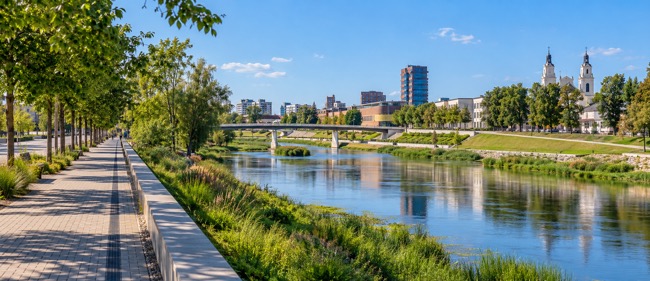
Panevėžys is in central Lithuania and suits people who value a compact city without giving up basic infrastructure. Its position between Vilnius, Kaunas and Riga is practical for logistics and travel, while the local economy is linked to manufacturing, processing, transport, retail and services. The Nevėžis River, parks and renewed public spaces create a calm urban rhythm.
Panevėžys is best viewed as a place for stable daily life rather than a substitute for Vilnius in the number of international vacancies. Housing is easier to find at more moderate rents, and routes to school, shops and work are shorter, but career growth in specialised roles may require remote work or regular travel. For a family, it can be a sensible choice when work and income are defined in advance.
PANEVĖŽYS: KEY POINTS
| Factor | What to consider |
| Work | Manufacturing, processing, logistics, retail, transport and services |
| Housing | Moderate rents and a calmer market than Vilnius |
| Transport | Short routes inside the city and a convenient position for travel across the country |
| Lifestyle | A compact environment with parks and the Nevėžis riverfront |
| Best suited to | Families, manufacturing specialists and remote workers |
Housing budget and first expenses
A move requires savings not only for rent, but also for the deposit, utilities, phone service, transport and the first purchases for a home. Average prices in Lithuania provide a baseline, but the actual budget depends on the city, district, building efficiency and rental terms.
IMPORTANT
Ask to see winter utility bills before signing a rental agreement. Their size depends on the condition of the building, apartment size and heating system, so the same advertised rent can lead to very different total costs.
For independent renting, it is sensible to keep enough reserve for the first month and the deposit, which is often equal to one month’s rent. If choosing a property before arrival, confirm which utilities are included, how rent can be revised and whether furniture or appliances are provided.
MAIN MONTHLY EXPENSES IN LITHUANIA
| Expense | Euro |
| One-bedroom apartment in the city centre | €542.50 |
| One-bedroom apartment outside the centre | €395.79 |
| Utilities for an 85 m² apartment | €195.01 |
| Monthly public-transport pass | €37.50 |
| Broadband internet, monthly | €14.67 |
Your relocation reserve should also cover travel, first purchases and any period spent looking for work. The savings calculator can turn that target into a monthly savings plan.
What changed over the last year
Lithuania’s minimum monthly wage increased to €1,153 gross on 1 January 2026, and the minimum hourly rate rose to €7.05. The law allows the monthly minimum only for unskilled work. For an experienced specialist, an offer at that level requires especially careful checking of duties, working hours and growth prospects.
In the first quarter of 2026, average gross monthly earnings reached €2,526.80, while average net pay was €1,514. National gross earnings then rose by a further 2.9% in the second quarter. This increases the difference between the capital’s labour market and regional cities: lower rent outside Vilnius does not always compensate for fewer vacancies.
For a long-term move, the city should match the real basis of residence. The rules for a residence permit in Lithuania differ for work, study, business and family routes, and the registered address should reflect where you will actually live and meet the conditions of your status.
FREQUENTLY ASKED QUESTIONS
Which Lithuanian city is best for work?
Vilnius has the widest range of vacancies, especially in IT, finance, international services and start-ups. Kaunas is strong in engineering and manufacturing, while Klaipeda is important for logistics and the port economy.
Where is it cheaper to live in Lithuania?
Siauliai and Panevėžys usually have more moderate rents than Vilnius. Kaunas and Klaipeda sit between them, but the final cost depends on the district, condition of the property and utility bills.
Is Klaipeda suitable for permanent living?
Yes, for people who value the sea, a compact city and work in logistics, port activities, manufacturing or services. Its smaller job market and humid, windy climate should be considered.
Is a car necessary in Lithuania?
Many residents in Vilnius, Kaunas and Klaipeda can rely on public transport. A car is more useful in suburbs, for intercity travel and for some family routes in regional centres.
Is Lithuanian necessary for relocation?
English can help when starting in an international environment, but Lithuanian matters for long-term integration, some vacancies, public authorities and daily life outside the capital.
Sources
- State Data Agency of Lithuania — population, employment and wage statistics.
- Ministry of Social Security and Labour of Lithuania — minimum wage and labour rules.
- Numbeo — indicators for housing, services, transport and communication costs in Lithuania.
Founder and Editor-in-Chief of WageCentre, with a degree in finance and 15+ years of professional experience. He writes about salaries, taxes, labour markets, immigration and financial planning for relocation.
Comments